
Sending luggage in Japan — what it costs, and the size rule that decides the price
Luggage forwarding calculator
The train and the courier disagree about the same case
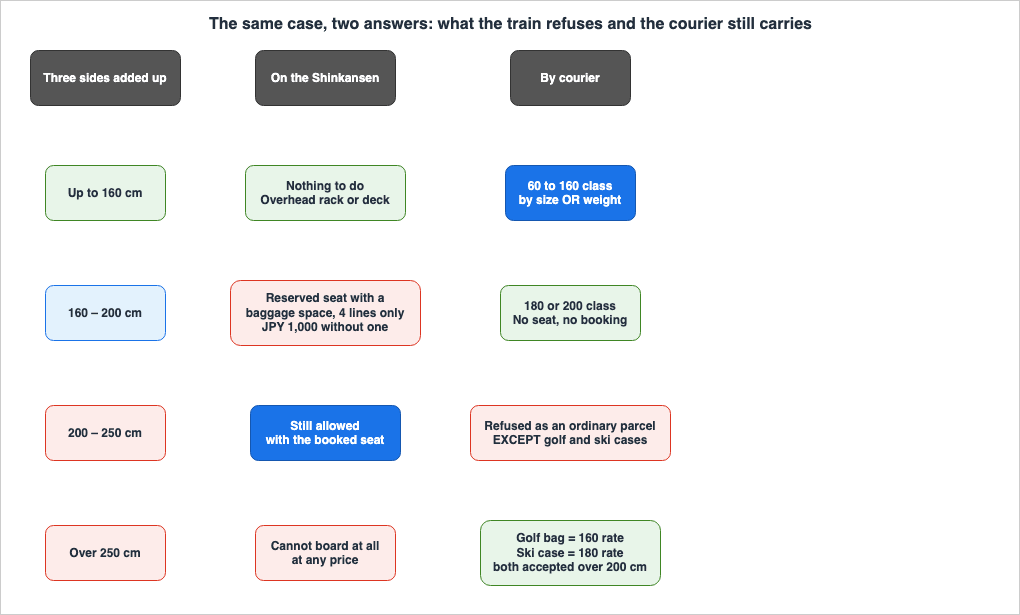
Luggage forwarding between hotels, stations and airports is ordinary in Japan and is what residents do rather than dragging a case onto a train. An ordinary parcel is not same-day: it arrives the next day or later, so it goes ahead of you. It is also the answer when the baggage seats are sold out.
A few paid services do deliver on the same day, on set routes only. JR Central points Shinkansen travelers to LUGGAGE EXPRESS, run by JTB: you leave the bag at a hotel or station and collect it that day at the hotel at your destination, between Tokyo, Kyoto and Osaka. Yamato's Osaka service delivers the same day to parts of Osaka, Kyoto and Kobe, from hotels with a baggage desk. Both have their own areas, cut-off times and prices, which are not the parcel fares below — check the service's own page before you plan a day around one.
The size class is the larger of two readings
This is the rule that decides the price, and it is almost never translated. Yamato states it plainly: compare the total of the three sides against the actual weight, and the larger of the two determines the class.
So an 80 cm box weighing 8 kg is not an 80 — it is a 100, because 8 kg falls in the 100 band. A dense bag of books costs more than a bulky bag of clothes of the same shape.
| Class | Three sides | Weight |
|---|---|---|
| 60 | up to 60 cm | up to 2 kg |
| 80 | up to 80 cm | up to 5 kg |
| 100 | up to 100 cm | up to 10 kg |
| 120 | up to 120 cm | up to 15 kg |
| 140 | up to 140 cm | up to 20 kg |
| 160 | up to 160 cm | up to 25 kg |
| 180 | up to 180 cm | up to 30 kg |
| 200 | up to 200 cm | up to 30 kg |
No single side may exceed 170 cm, and anything that has to stay upright is limited to 100 cm on a side. Cool delivery stops at the 120 class.
Two things are accepted above the 200 cm limit
The ordinary ceiling is 200 cm across three sides and 30 kg. Two sports items are exempt from the size ceiling and carry a fixed rate instead:
- A golf caddy bag — charged at the 160 rate, and accepted even above 200 cm.
- A ski or snowboard all-in-one case — charged at the 180 rate, also accepted above 200 cm. Two sets per package at most.
The 30 kg weight ceiling still applies to both, and both are excluded from the multi-parcel discount. A suitcase gets no such treatment: it is charged on its measured size and must stay inside 200 cm.
This matters because it is the only route left for a package the Shinkansen will not take. Over 250 cm a case cannot board a train at any price — but a 210 cm ski case is still a parcel.
The discounts, and what each one excludes
- JPY 100 off for dropping it off yourself at a branch, an agent or a convenience store. Some convenience stores will not accept 180 or larger.
- JPY 150 off instead of 100 for Kuroneko Members who drop off at a branch and produce the label at the in-branch terminal. Yamato lists it as a separate discount that cannot be combined with the JPY 100 one; the calculator counts it as JPY 50 more.
- JPY 60 off for a label made digitally — reserved in Yamato's app, through its send-by-smartphone service, with its C2 label system, or with a pick-up booked on the web. Yamato sets the conditions for each route separately, so the calculator does not apply this one.
- JPY 100 per parcel for two or more going to the same address on a multi-parcel label, prepaid only — excluded for the airport service, cool delivery, compact, golf, ski, round-trip, time service and international. Yamato adds that suitcases and boston bags may be excluded depending on size, without saying where the line is.
The fares here are Yamato's cash fares. Yamato publishes a second table for cashless payment — card, e-money or a code payment. On 25 October 2026 it was lower by JPY 1 to 9 in 1,052 of the 1,152 zone-to-zone cells and the same in the other 100, so the cash fare is a safe estimate however you pay.
The same-prefecture rate is separate and lower
When both ends are in one prefecture there is a reduced rate — JPY 1,410 for a 100 class against the JPY 1,530 zone rate in Kanto, for instance. It applies to prepaid parcels collected from an address or dropped off at a branch, a PUDO point, a delivery locker, or a convenience store if the label was made with Yamato's smartphone service. It is not available for parcels sent from Okinawa, which is why that one square of the table is blank, and it does not cover the airport, golf or ski services.
Sending it to the airport costs JPY 660 more
Yamato adds a JPY 660 airport fee to anything sent to an airport, and the airport service gets no multi-parcel discount. Hand it over two days before you fly — three from some areas — by the counter's cut-off time; it goes to the airport you leave from. The calculator adds the fee when you pick an airport as the destination.
What this page does not cover
Other counters at airports, run by airport handling companies, price differently from Yamato's own service, and the hotel desk that arranges it for you may add its own handling fee. Other carriers have their own tables. The figures here are Yamato's published cash fares, which is the yardstick everything else is quoted against.
Related
- Skis and bikes on domestic flights — checking them in with JAL or ANA instead.
- Shinkansen luggage rules — what the train requires, and why this page exists.
- Airport charges — what leaving costs before the fare.
- Trip checklist — the rest of what your dates decide.
- Highway and overnight buses — the size and weight a bus will take in its hold.
- Sending your shopping home by mail — when it is going abroad rather than across Japan.
- Coin lockers at Tokyo stations — leaving the bag for a day instead, and the three-day limit.
Sources
- Yamato Transport — 宅急便のサイズについて — The size table, the rule that the class is the larger of the two readings, and the fixed rates for golf and ski items.
- Yamato Transport — 宅急便運賃一覧表:全国一覧(現金でのお支払い) — The full national fare table — twelve zones by twelve zones by eight size classes. All 1,152 cells and the 96 same-prefecture fares compared with the data on 2026-10-25: no differences.
- Yamato Transport — 宅急便運賃一覧表:全国一覧(キャッシュレス決済) — The cashless table, compared cell by cell with the cash table on 2026-10-25.
- Yamato Transport — 空港宅急便 — The JPY 660 airport fee, the hand-over deadline two days before the flight, and the list of discounts (drop-off JPY 100, members' drop-off JPY 150, digital JPY 60, multi-parcel JPY 100).
- Yamato Transport — FAQ: skis and snowboards 170 cm or longer
- JR Central — Bringing large luggage on the Shinkansen — "By leaving your baggage at a hotel or station, you can have it delivered to your destination hotel on the same day. Please see LUGGAGE EXPRESS"
- LUGGAGE EXPRESS (JTB) — Same-day delivery between Tokyo, Kyoto and Osaka; areas, cut-off times and prices are on its own pages.
- Yamato Transport — Baggage delivery and storage services (Osaka) — Same-day delivery to parts of Osaka, Kyoto and Kobe, from hotels with a front desk for checking baggage.
Figures on this page last checked against the sources above on 2026-10-25.