
Japan trip checklist — built from your dates, not from a generic list
Trip checklist
Two orders that are the opposite of what you expect
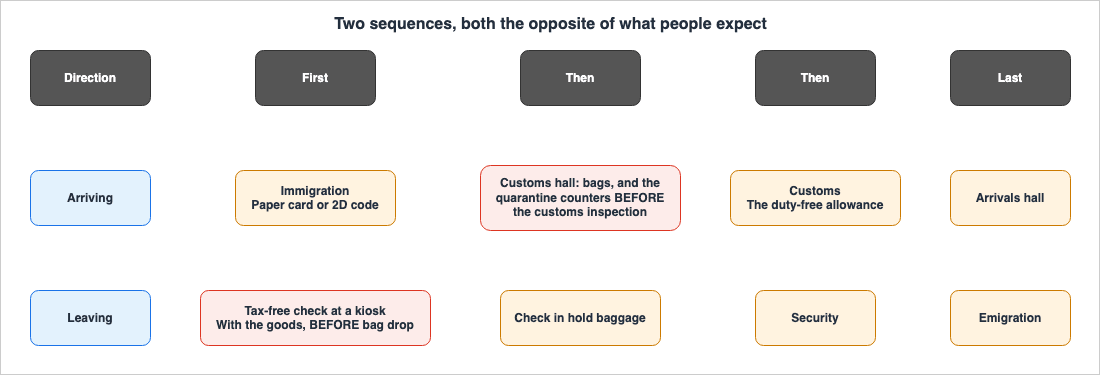
Almost everything on a Japan checklist is advice you can ignore without consequence. Two items are not, and both are about sequence rather than substance.
- Arriving: quarantine comes before the customs inspection. Anything of animal or plant origin is declared at the animal and plant quarantine counters inside the customs hall, before you reach the customs inspection — not to the customs officer.
- Leaving: the tax-free check comes before bag drop. It is done at a kiosk terminal in the departure lobby (or, at seven airports, online with Visit Japan Web on the lobby's Wi-Fi), and customs cannot confirm goods that are already in the hold, so the refund is lost the moment your suitcase goes.
Neither can be undone by explaining yourself afterwards.
Visit Japan Web is optional
English coverage almost universally calls it required. It is not. Both the Immigration Services Agency and Japan Customs describe electronic submission as recommended. Without it you fill in the paper disembarkation card and the paper customs declaration, exactly as travelers did before it existed, and you are admitted.
What you give up is speed: the electronic declaration gates at seven airports, the joint customs and immigration kiosks at Narita, Haneda, Kansai and Fukuoka (all three Narita terminals since 24 September 2026), and a shorter queue at a busy hour. Worth doing — but if your phone dies in the immigration hall, nothing has gone wrong.
Two details that do catch people:
- One code, since 25 January 2024. Immigration and customs used to need two separate 2D codes. They were unified. Guides written before that date tell you to prepare two.
- Everyone registers individually, including children, and the gates need an IC passport. A family cannot travel on one adult's code.
The immigration part — the electronic disembarkation card — is for new entries only. It cannot be used for re-entry, including the special re-entry permission a resident uses, for special landing permissions, or by people covered by the US–Japan or UN Forces Status of Forces Agreements or a Reciprocal Access Agreement. The customs part is different: Japan Customs recommends it to everyone entering, returning residents included.
Why the checklist is dated
Two of the rules on this site change on fixed days in autumn 2026, and each one changes what belongs on your list:
| Date | What changes on your checklist |
|---|---|
| 1 Oct 2026 | "Buy the rail pass wherever you like" becomes "buy it on the official site" — an overseas agency starts charging more |
| 1 Nov 2026 | "Nothing to do at the airport" becomes "the tax-free customs check at a kiosk before bag drop, with the goods" |
A generic checklist cannot express that, which is why this one takes your dates and the other calculators on this site read from the same dated rules. Lodging tax changes too — Tokyo's becomes 3% of the room rate, with a ¥13,000 threshold, on 1 April 2027 — but it differs city by city, so it has its own calculator rather than a line here.
What is deliberately not here
Packing lists, SIM cards, pocket wifi, IC card advice, and "download these five apps". They are matters of preference and there are thousands of good pages about them. Everything above is a procedure with a published rule behind it and a consequence for getting it wrong.
Related tools
- What you cannot bring in — the quarantine half of arrival.
- Duty-free allowance — the tax half.
- Tax-free refund — the kiosk check you must not miss on the way out.
- Rail pass — where you buy it now matters.
- Peak season checker — whether your dates are the busy ones.
Sources
- Digital Agency — Visit Japan Web
- Digital Agency — Unified 2D codes for immigration and customs (25 January 2024)
- Immigration Services Agency — Submitting the disembarkation record — Electronic submission is described as recommended, not required.
- Japan Customs — The declaration of accompanying and unaccompanied articles
- Japan Customs — Electronic declaration gates at seven airports
- Japan Customs and the Immigration Services Agency — Joint kiosks at Narita Terminals 1 and 2 from 24 September 2026 — Already running at Kansai T1/T2, Haneda T2/T3, Narita T3 and Fukuoka.
Figures on this page last checked against the sources above on 2026-09-01.