
Shinkansen luggage rules — measure your suitcase before you book the seat
Shinkansen luggage checker
Four limits, not one
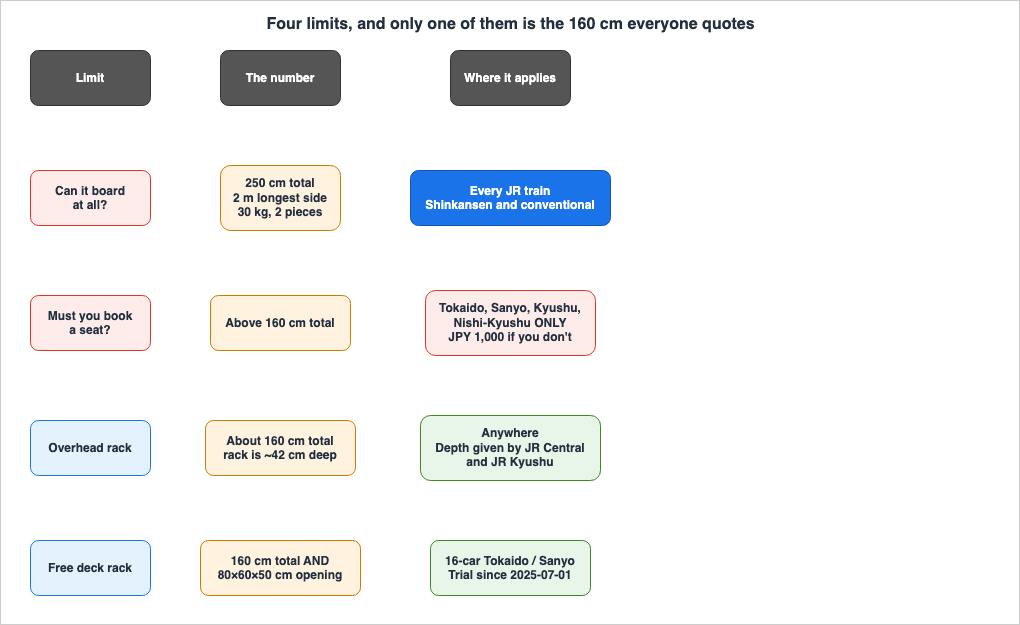
English write-ups of this rule almost always give one number — 160 cm — and stop. That number answers only one of the four questions a suitcase actually runs into, and it is not the one that decides whether you can board.
The number that decides whether you board is 250, not 160
The JR group's hand-baggage rule applies to every train it runs, Shinkansen and local alike:
- Two pieces per person — umbrellas, walking sticks and handbags are not counted.
- 250 cm for length plus width plus height, and no more than 2 m on the longest side.
- 30 kg per piece.
Above that, the answer is not "pay a fee". It is that the bag does not go on the train.
The 160 cm rule covers four lines, and only four
Over 160 cm total, on the Tokaido, Sanyo, Kyushu and Nishi-Kyushu Shinkansen, you must reserve a seat with an oversized baggage space. It costs nothing extra — it is the same price as any reserved seat — but it has to be done when you buy the ticket. Board without one and the charge is JPY 1,000, and a member of the crew decides where the bag goes.
It does not apply to the Tohoku, Hokkaido, Joetsu or Hokuriku Shinkansen, and it does not apply to conventional lines. JR Kyushu states this in as many words: the advance reservation is for those four lines only. So the same suitcase that needs a booked seat from Tokyo to Kyoto needs nothing at all from Tokyo to Sendai.
What the reservation actually gets you
The last row of certain reserved cars, with the space behind the seat for luggage. Two things about that are worth knowing before you book:
- The space is shared by everyone in that back row who booked it — five people in an ordinary car of a 16-car train, four in a Green car or on the 8-car Mizuho and Sakura.
- A full space can stop your seat reclining. JR says so itself at the point of booking.
There are not many of these seats. On a 16-car Tokaido or Sanyo train the joint operators' own figures are 57 on a Nozomi, 42 on a Hikari and 17 on a Kodama. On the Kyushu Shinkansen an N700 series has 20; the 800 series has two or four. Reservations open a month ahead, at 10:00 on the same date of the previous month, and if they sell out the published advice is to take a different train or split the bag.
⚠ There is no oversized baggage space in unreserved cars, or in some reserved cars. "I'll just take the unreserved car" is not a way around this on a train that has reserved seats. The exception is a train with no reserved ordinary seats at all: on the Sanyo Shinkansen, for a trip between stations from Shin-Osaka to Hakata, and on the Kyushu and Nishi-Kyushu Shinkansen, such a train has no baggage-space seats to book, so no reservation is needed. On the Tokaido Shinkansen JR Central asks you to take a train where the seats can be booked, or a Green car.
From 1 October 2026 some Tokaido and Sanyo trains carry Supreme Class Cabins (cars 7 and 10), private rooms booked through Express Reservation or smartEX. They may take an oversized bag of 160 to 250 cm without a separate baggage-space seat, and car 7 has its own locked area for a bag up to 80 × 60 × 40 cm.
⭐ Strollers, instruments and sports gear do not need the reservation
The oversized baggage reservation rule does not apply to a stroller, a musical instrument, sports equipment or a wheelchair. All three operators say so, and JR Central says it in English too. The general JR limit still applies — 250 cm across the three dimensions — except that sports equipment and instruments longer than 2 m may be carried in a dedicated bag or case if they can be held upright in the car.
The catch is the other way round: if you want the baggage space for one of them, you still have to reserve the seat.
The deck rack that stopped needing a reservation
On 1 July 2025 the racks in the deck of 16-car Tokaido and Sanyo trains — six per train, on cars 3, 5, 7, 9, 13 and 15 — became free to use without a reservation. It is a trial, announced on 4 April 2025 and running "for the time being", with the end date to be announced separately.
Two limits apply to it at the same time, and they are different in kind:
- 160 cm total. Oversized baggage may not go here even during the trial — that still means booking the seat.
- The opening. The upper slot is 80 × 60 × 50 cm and the lower one 80 × 60 × 40 cm. A bag can be inside 160 cm total and still not go in: 100 × 30 × 30 adds up to 160 and will not pass an 80 cm opening.
The rack is away from your seat, so it locks — with a contactless IC card of your own. A transport IC card works; some cards and some phones do not. JR states plainly that it takes no responsibility for theft or damage.
Where a bag that is not oversized actually goes
JR Central publishes measurements for the ordinary racks on the Tokaido Shinkansen, and JR Kyushu the same figures for its own trains:
- Overhead rack: about 42 cm deep, taking roughly 160 cm total — their worked example is 30 × 50 × 80 cm.
- Footwell: roughly 120 cm total — 25 × 40 × 55 cm. In a Green car the footrest takes that space, so the bag goes on the rack instead.
Bicycles, pets and what is refused outright
- A bicycle must be folded or dismantled and completely inside its bag. A wheel sticking out, an unfolded bike in a bag, and wheeling it aboard are each refused.
- A small dog, cat or similar animal travels entirely inside a carrier, head included. The carrier may total 120 cm across its three dimensions, and animal plus carrier may weigh 10 kg. Carrying it in your arms, on a leash, in a sling, or in an over-size pet buggy are all refused. A paid hand-baggage ticket is bought at the gate before boarding — we have not verified the current price from a JR page, so this site does not quote one.
- A guide, service or hearing dog accompanying its user boards as it is, with no ticket.
Refused on any train: dangerous goods, blades that are not properly wrapped (the packing standard is a 2018 transport ministry guideline), anything likely to injure other passengers, wild animals and snakes, and anything unclean or giving off a smell.
Related
- Japan Rail Pass calculator — whether the pass is worth it, and why the price now depends on where you buy it.
- Trip checklist — what else your dates decide.
- Duty-free allowance — what is inside those bags, for customs.
Sources
- JR Central — 東海道・山陽・九州・西九州新幹線への特大荷物のお持ち込みについて
- JR Central (English) — Oversized baggage — Its FAQ gives the Tokaido Shinkansen overhead rack depth (approx. 42 cm) and the footwell size.
- JR West — 新幹線への「特大荷物」の持ち込みについて — States the 160 cm limit for the reservation-free deck rack and the all-unreserved-train exception on the Sanyo Shinkansen.
- JR Kyushu — 特大荷物 — The fullest FAQ: the deck slot dimensions, the rack depth for its own trains, and the statement that conventional lines are out of scope.
- JR Central and JR West, joint release, 4 April 2025 — 東海道・山陽新幹線 予約不要の車内荷物置場の試行について (PDF)
- JR Group — 手回り品のご案内 (as of July 2021, PDF)
Figures on this page last checked against the sources above on 2026-09-01.