
Japan Rail Pass calculator — and why the price now depends on where you buy it
Since 2026-10-01 the nationwide Japan Rail Pass has had two prices. Bought through an overseas travel agency, a 7-day ordinary pass went from ¥50,000 to ¥53,000. Bought on the official online reservation site, it stays at ¥50,000 — with no announced end date.
The second half is the one to act on: the online price is held for a limited period, and JR Group will announce when that ends.
Rail pass calculator
Prices last checked against the official pass site on —. Everything runs in your browser.
One pass, two prices since 1 October 2026
The revision JR Group announced on 9 April 2026 took effect on 1 October 2026, and only for overseas agencies. The official price page now shows two tables — online at the earlier prices, agency at the revised ones — and until 30 September it also showed the agency prices before the revision. All three are below.
| Where you buy | Ordinary 7 / 14 / 21 days | Green 7 / 14 / 21 days |
|---|---|---|
| Official online reservation (no date qualifier) | ¥50,000 / ¥80,000 / ¥100,000 | ¥70,000 / ¥110,000 / ¥140,000 |
| Overseas agency, purchases by 30 Sep 2026 | ¥50,000 / ¥80,000 / ¥100,000 | ¥70,000 / ¥110,000 / ¥140,000 |
| Overseas agency, purchases from 1 Oct 2026 | ¥53,000 / ¥84,000 / ¥105,000 | ¥74,000 / ¥116,000 / ¥147,000 |
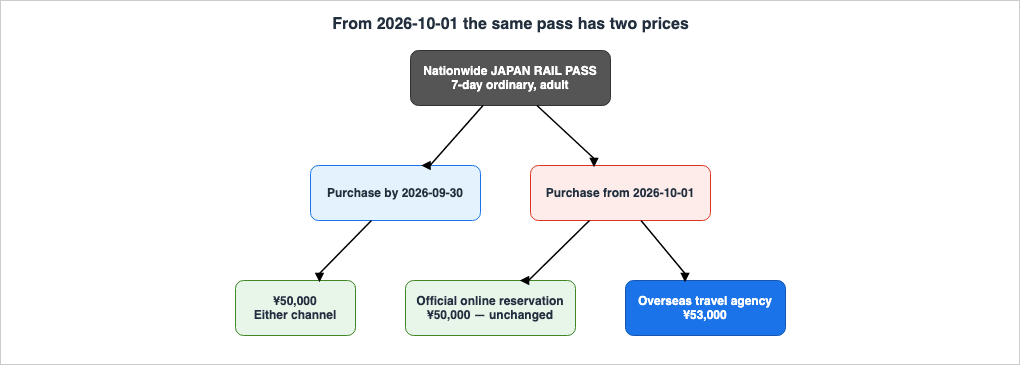
So the increase is real, and it is confined to Exchange Orders sold by overseas agencies. The official online service is holding the earlier prices for a limited period — 一定期間 in JR Group's Japanese release — and the end of that period is to be announced.
For a couple buying two 7-day ordinary passes on the same day, that is ¥6,000 — the difference between paying the agency price and paying the online price, for as long as the online hold lasts.
Which channel suits you anyway
| Official online | Overseas agency | |
|---|---|---|
| Price since 1 Oct 2026 | Unchanged | 5–6% higher for adults; 5–8% for children |
| Who can buy | Not Japanese nationals living abroad | Everyone eligible for the pass |
| Currency | Settled in yen | Local currency, converted at the bank selling rate on the day the Exchange Order is issued |
| Exchange-rate risk | Yours, at the card's rate | Fixed when the Exchange Order is issued, which may differ from the rate when you travel |
| Child age rule | Judged on the payment date | Judged on the Exchange Order issue date |
The child rule is worth reading twice if you are traveling with an eleven-year-old. A child is 6–11 at the time of use, but if they are 11 on the payment date (online) or on the issue date (agency), they keep the child price even if they turn 12 before the trip.
The pass is not the default answer any more
In October 2023 the nationwide pass went from ¥29,650 to ¥50,000 — a 69% rise that changed the arithmetic for most itineraries. The 2026 revision is much smaller, but it lands on a price that was already high enough to lose to individual tickets on the classic routes.
The break-even is simply the pass price: your fares have to add up to more than it before the pass is worth buying. A week centered on Tokyo with day trips will not get there. Three or more long-distance Shinkansen legs inside seven days usually will.
Why we do not ship a fare table
Every competing calculator hard-codes route fares. It makes the tool feel complete, and it is the part that goes stale first: operators revise fares on their own schedules, and a fare that is two revisions old produces a confident, wrong verdict.
So this calculator asks you for the totals. Get them from a route search on the day you decide, and the comparison is as current as your search. What we do keep current — because we read the tariff pages ourselves — is the pass price, by channel and by purchase date.
Three things that change the answer
NOZOMI and MIZUHO are not included
The fastest Tokaido, Sanyo and Kyushu Shinkansen services are outside the base pass. Pass holders can buy a supplement ticket at the station, or take HIKARI or SAKURA on the same route for roughly 20–30 minutes more. If your plan assumed NOZOMI journeys, add the supplements to the pass side of the comparison.
Regional passes often win
If the trip stays inside one region, a regional pass is usually cheaper than the nationwide one. Kansai, Hokuriku and Kyushu all have their own. The nationwide pass earns its price on itineraries that cross the country.
The pass covers JR lines, plus a few named others
Besides JR Group trains, the official scope page lists the Tokyo Monorail, set sections of the Aoimori, IR Ishikawa, Ainokaze Toyama and Hapi-Line Fukui railways, local JR Bus routes (not expressways) and the JR West Miyajima ferry. Subways, other private railways and most airport express services belong to other operators and are not included. Those fares should be added to both sides of your comparison, or left out of both — just not added to only one.
Related tools
- Japan lodging tax calculator — the other per-night cost that is not in the price you were quoted.
- Tax-free refund calculator — what comes back on your shopping, and what changes on 1 November 2026.
- How we verify — why the pass prices here are dated, and the fares are not shipped at all.
Sources
- JAPAN RAIL PASS official site — Types and prices — Since 2026-10-01 publishes two tables: online (the earlier prices) and agency (the revised prices). Until 2026-09-30 it also published the agency prices before the revision.
- JR Group press release, 9 April 2026 — revision of Japan Rail Pass prices — PDF, Japanese. jreast.co.jp blocks non-browser clients, so the figures here were taken from the official pass site, which publishes the same tables.
- JR West copy of the same release (PDF, Japanese) — 「一定期間(※)価格を据え置きます」 — the online price is held for a limited period, its end to be announced.
- JAPAN RAIL PASS official site — Scope of validity
- JAPAN RAIL PASS official site — Purchase online — "This service is not available to Japanese nationals living abroad."
Figures on this page last checked against the sources above on 2026-09-26.