
Japan lodging tax calculator — the charge that is not in your booking price
Lodging tax calculator
Rates last checked against each authority's own page on —. The calculation runs in your browser; nothing you type leaves the page.
Why this is not in the price you were quoted
Japanese lodging tax is a local tax — set by the municipality, the prefecture, or both — and collected by the accommodation on the local government's behalf. Booking platforms generally show the room rate and the 10% consumption tax, and leave the lodging tax to be settled at the property — which is why a great many travelers first hear about it at check-in, in cash, at the end of a long flight.
For two people on a three-night stay in Kyoto at ¥18,000 a night, it is ¥2,400. Not ruinous; also not zero, and entirely predictable.
The base is the room-only rate, per person, per night
Every jurisdiction checked here taxes the same thing: the price of the room per person per night with meals and consumption tax stripped out, and service charge left in. In Japanese this is sudomari ryōkin — the "just sleeping" rate.
That is not the number on your booking confirmation if breakfast is included. A ¥22,000 half-board rate might be ¥18,000 of room and ¥4,000 of food, and the ¥4,000 is not taxed. In several places the difference straddles a band boundary and changes the tax, which is why the calculator asks for the room-only figure rather than the total.
2026 is the year this became hard to keep track of
At the end of 2025, seventeen local governments levied a lodging tax — three prefectures and fourteen municipalities. On 1 October 2026 the Ministry of Internal Affairs counted 49 in force (seven prefectures and forty-two municipalities), and eighteen more had consent but had not started yet, which takes the total to 67. Several of the long-standing ones changed their rates in the same window.
| Where | What changed | From |
|---|---|---|
| Osaka Prefecture | Tax-free threshold cut from ¥7,000 to ¥5,000 and rates raised | 1 Sep 2025 |
| Miyagi Prefecture | New ¥300 from ¥6,000 a night, across the prefecture — split ¥100 / ¥200 with the city inside Sendai | 13 Jan 2026 |
| Kyoto City | Three bands became five; the top band went from ¥1,000 to ¥10,000 a night | 1 Mar 2026 |
| Hokkaido | A prefecture-wide tax introduced, stacking on top of most municipal ones | 1 Apr 2026 |
| Kutchan Town | Percentage rate raised from 2% to 3% | 1 Apr 2026 |
| Hiroshima Prefecture | New ¥200 from ¥6,000 a night | 1 Apr 2026 |
| Kumamoto City | New flat ¥200 | 1 Jul 2026 |
| Morioka City | New flat ¥200 | 1 Oct 2026 |
| Nasu Town | New, in six bands from ¥100 to ¥3,000 | 1 Oct 2026 |
| Oita Prefecture | New, in four bands from ¥100 to ¥2,000 — the start day has not been published | Jan 2027 or later |
| Okinawa Prefecture | New 2%, capped at ¥2,000 — shared with six municipalities, including Nago | 1 Feb 2027 |
| Wakkanai City | New flat ¥200, on top of Hokkaido's band | 1 Mar 2027 |
| Shirahama Town | New, in four bands from ¥200 to ¥1,000 | 1 Mar 2027 |
| Tokyo | Fixed amounts replaced by a flat 3%; threshold raised to ¥13,000; extended to simple lodgings and minpaku | 1 Apr 2027 |
| Tomakomai, Yamagata | New 3% (in Tomakomai, including Hokkaido's share) | 1 Apr 2027 |
| Fujiyoshida, Fujikawaguchiko, Kagoshima, Ibusuki, Unzen | New: ¥200 flat at the two Fuji towns, Kagoshima and Ibusuki; ¥100 / ¥350 in Unzen | 1 Apr 2027 |
| Nagasaki City | Bands redrawn: ¥100 below ¥6,000 (was below ¥10,000), ¥300 from ¥6,000 (was ¥200 from ¥10,000), ¥500 from ¥20,000 as before | 1 Apr 2027 |
| Kitahiroshima City | New 3%, including Hokkaido's share | 1 Oct 2027 |
Kyoto's ¥10,000 top band is the highest fixed amount in Japan — only an uncapped percentage, such as Kutchan's 3%, charges more, and only on very expensive stays. It applies to stays of ¥100,000 or more per person per night, so most visitors will never meet it. Kyoto divides the room charge by the number of guests, so a couple sharing a ¥240,000 suite — ¥120,000 each — now pay ¥20,000 a night in lodging tax, against ¥2,000 before the change. The same couple in a ¥120,000 suite (¥60,000 each) pay ¥8,000.
Fixed bands or a percentage — and why Tokyo switched
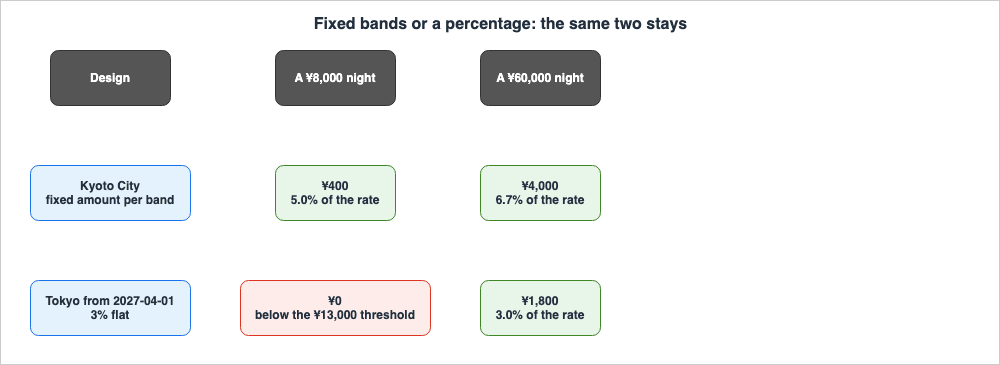
Two designs are in use. Most places charge a fixed amount per band: Kanazawa charges ¥200 below ¥20,000 and ¥500 above it. Kutchan charges a straight percentage of the rate.
Tokyo gives its reason for moving to 3% as fairness and neutrality: the charge should follow the room rate. The arithmetic shows what that means. Under fixed amounts, as room rates rose, expensive stays paid a steadily smaller proportion — ¥200 on a ¥15,000 room is 1.3%, ¥200 on a ¥150,000 room is 0.13%. A percentage keeps the burden proportional to the rate.
Thresholds are where the surprises live
A tax-free threshold means stays below a certain nightly rate are not taxed at all — and the threshold varies more than the rates do.
- Kyoto has none. A ¥3,000 hostel bed is taxed ¥200. The city's stated basis is to ask every guest for a small share in return for the city services they use — "broadly and thinly" — while banding the amount by what the room costs.
- Kanazawa had none either until it introduced a ¥5,000 threshold in October 2024.
- Osaka lowered its threshold from ¥7,000 to ¥5,000 in September 2025, which means a mid-range stay that used to be untaxed is now taxed.
- Tokyo exempts stays under ¥10,000 until 31 March 2027. From 1 April 2027 it exempts stays under ¥13,000, and a stay of ¥13,000 or more pays 3% of the whole room-only rate.
So "budget accommodation is exempt" is true in Tokyo, false in Kyoto, and was false in Kanazawa until recently.
Two taxes, one line on the bill
Several places charge a prefectural tax and a municipal tax at the same time, collected together so that you see a single figure.
- Fukuoka City — the ¥200 below ¥20,000 is ¥150 city and ¥50 prefecture. Kitakyushu's flat ¥200 splits the same way.
- Hokkaido — the prefecture introduced its own tax on 1 April 2026 (¥100 / ¥200 / ¥500 by band), and in most towns it stacks on top of the municipal tax. In Hakodate a ¥120,000 night is ¥2,000 city plus ¥500 prefecture, so ¥2,500. The exceptions fold it into a single 3%: Kutchan, Niseko from November 2026, and in 2027 Tomakomai and Kitahiroshima.
- Kutchan — the 3% includes the prefectural share. The town raised its own rate specifically so that guests would still see one clean percentage after the prefecture arrived.
You never have to work this out yourself. It does explain why two neighboring towns in the same prefecture quote very different-looking numbers for what is substantially the same tax — and why a Hokkaido stay costs more per night from April 2026 than the town's own published rate suggests.
Stays that cross a rate change
Lodging tax is charged per night, so a stay that begins before a change and ends after it is taxed under both rules. A Kyoto stay from 28 February to 2 March 2026 is two nights: the night of 28 February at the old rate and the night of 1 March at the new one (2026 is not a leap year). The calculator walks your nights one at a time, so a stay that straddles a change — or starts before a tax exists — is charged night by night, and the result shows each part.
Exemptions exist, and you probably cannot claim them
Most ordinances exempt school excursions, and some exempt diplomatic stays or, temporarily, people displaced by a disaster. These are claimed through the accommodation with documentation from the school or authority, not by the traveler at the desk.
What this calculator does not cover
It covers the jurisdictions whose own ordinance or tax page we have read. With municipalities being added every few months, a place missing from the list is not a place without a tax — check the city's own site, or the accommodation's booking terms, before assuming.
Two prefectures are handled as single entries because that is how the money works. Okinawa charges 2% whether or not your municipality also taxes: the prefecture takes 0.8% and the municipality 1.2%. Miyagi charges ¥300 everywhere; inside Sendai it is ¥100 prefectural plus ¥200 city tax. Hokkaido and Nagano stack, so their municipalities appear individually with the combined figure, and a plain "somewhere in Hokkaido" entry covers the towns that levy nothing of their own.
Where a rule has changed and we have not been able to confirm the new one, or a tax has been approved without a published start day, the calculator says so instead of showing ¥0 or carrying old figures forward — a wrong number that looks like an answer is worse than no answer. One entry is in that state today: Oita Prefecture. Its tax was consented to on 30 September 2026, but the only start the government has published is "January 2027 or later", so the calculator treats stays before 1 January 2027 as untaxed and gives no figure from that date.
Separately, onsen towns levy a bathing tax (nyūtōzei) on top of everything else. The Local Tax Act sets ¥150 per person per day as the standard, but towns vary it: Kushiro charges ¥300 at registered hotels and ryokan, and Beppu from ¥50 up to ¥500 depending on what the stay costs. It is a different tax with a different legal basis and is not calculated here.
Related tools
- Japan tax-free refund calculator — the consumption tax you can get back, and the 1 November 2026 change to how.
- How we verify — which sources this page was built from and when they were last read.
Sources
- Tokyo Metropolitan Bureau of Taxation — Accommodation Tax
- City of Kyoto — FAQ for guests on the lodging tax revision from 1 March 2026 (old and new rates)
- Osaka Prefecture — Accommodation Tax
- City of Kanazawa — Accommodation Tax
- City of Fukuoka — Outline of the Accommodation Tax
- Kutchan Town — About the Kutchan lodging tax
- Hokkaido Government — Hokkaido lodging tax — Publishes the combined figures for municipalities that also levy their own tax.
- City of Sapporo — Lodging tax
- City of Takayama — Lodging tax, for guests
- Niseko Town — Lodging tax from April 2026 (PDF)
- Hiroshima Prefecture — Outline of the lodging tax (in force from 1 April 2026)
- Miyagi Prefecture — Lodging tax (in force from 13 January 2026; the split inside Sendai)
- Fukuoka Prefecture — Lodging tax (the rate outside Fukuoka City and Kitakyushu)
- Morioka City — Introduction of the lodging tax (from 1 October 2026)
- Nasu Town — Lodging tax from 1 October 2026
- Akaigawa Village — About the lodging tax (from 1 November 2025)
- City of Kyoto — Lodging tax Q&A (the room charge is divided by the number of guests)
- Ministry of Internal Affairs and Communications — status of non-statutory local taxes — Used to track which municipalities have been given consent, and when.
- Ministry of Internal Affairs — 法定外税の状況 (as of 1 October 2026; PDF) — Lodging tax: 49 in force (7 prefectures, 42 municipalities); Oita, Okinawa and 16 municipalities consented but not yet in force.
- Ministry of Internal Affairs — consents of 30 June 2026 (Wakkanai, Tomakomai, Kitahiroshima, Yamagata, Fujiyoshida, Fujikawaguchiko, Nago) and 28 August 2026 (Unzen)
- Ministry of Internal Affairs — consent of 30 September 2026 to Nagasaki City's revised rates (PDF)
- Ministry of Internal Affairs — consent of 30 September 2026 to Kagoshima City's lodging tax (PDF)
- Ministry of Internal Affairs — consent of 30 September 2026 to Ibusuki City's lodging tax (PDF)
- Ministry of Internal Affairs — consent of 30 September 2026 to Shirahama Town's lodging tax (PDF)
- Ministry of Internal Affairs — consent of 30 September 2026 to Oita Prefecture's lodging tax (PDF) — Gives the start only as 令和9年1月以降 (January 2027 or later).
- City of Nagasaki — Outline of the lodging tax (the rates to 31 March 2027 and from 1 April 2027)
- Tomakomai City — 宿泊税 制度の内容について (the Hokkaido share is inside the 3%)
- Kitahiroshima City — 北広島市宿泊税 (道税控除方式)
- Nagano Prefecture — notice to travel agents (Nozawaonsen's 3.5% includes the ¥100 prefectural tax; PDF)
- Tokyo Metropolitan Bureau of Taxation — review Q&A (A2: why a percentage)
Figures on this page last checked against the sources above on 2026-09-01.