
Cherry blossom and autumn leaves — the published normals, and the fortnight of spread nobody quotes
Season checker
⛔ There is no forecast on this page, deliberately. Predicting this year's bloom is a product that private forecasters sell, and republishing their numbers would be passing off someone else's work. What is here instead is the meteorological agency's own record: the published normal, and what actually happened in each of the last six years.
The normal is not the useful number — the spread is
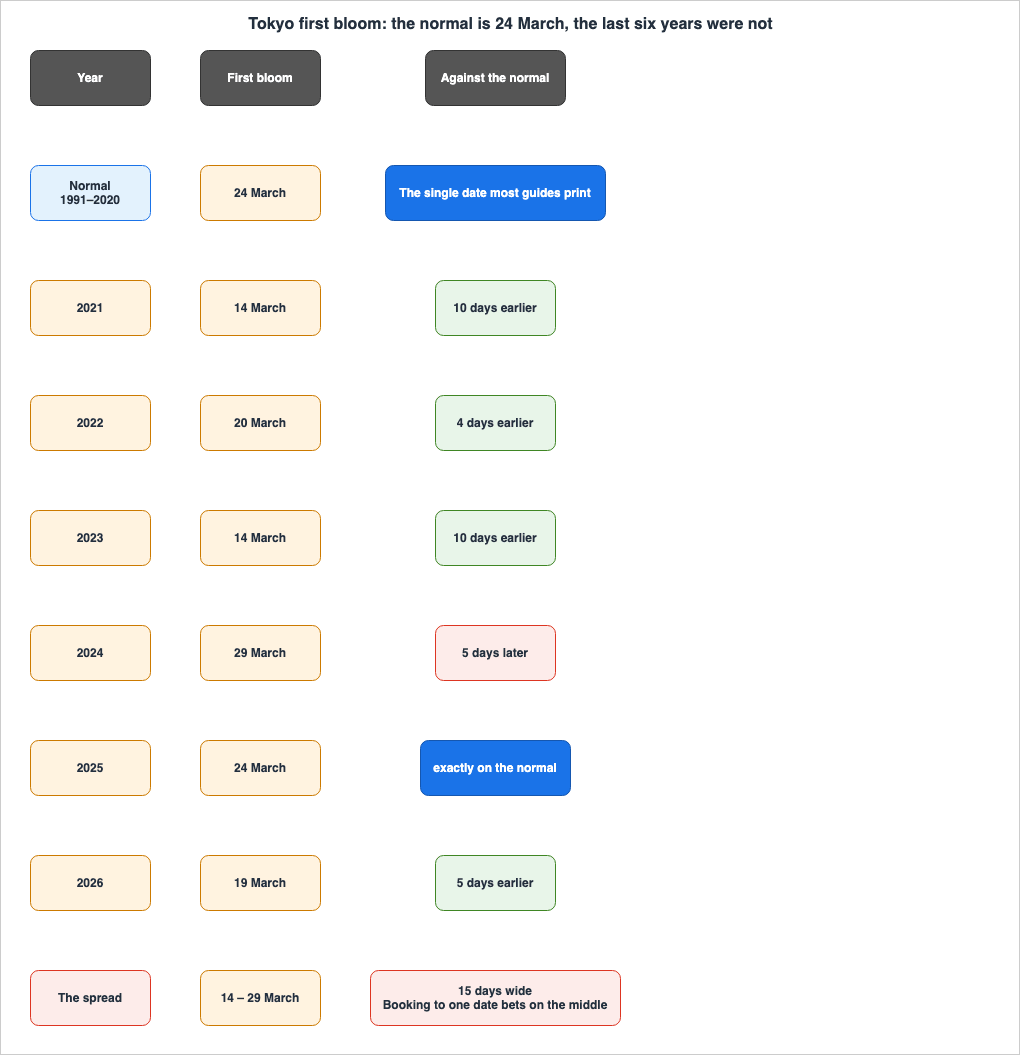
Almost every English page gives one date per city and stops. At Tokyo the published normal for first bloom is 24 March. Over the last six years, 2021 to 2026, first bloom actually landed between 14 March and 29 March: a window a fortnight wide. Booking a trip to the normal is betting on the middle of that.
The tool above shows both, so you can see what you are actually betting on rather than a single reassuring day.
⚠ Three things the guides leave out
1. First bloom is not the sight
開花 — first bloom — is the day five or six flowers open on the reference tree. That is a measurement, not a view. 満開 — full bloom, about 80 per cent of buds open — is the one to travel for, and the agency publishes it as a separate date, usually around a week later. A guide that gives you only the first-bloom date is sending you a week early.
2. It is not the same tree everywhere
The observation is on somei-yoshino across most of Japan — Sapporo and Hakodate included. Okinawa observes hikanzakura, a different species with different timing: its normal first bloom is in January — 16 January, 69 days before Kyoto's 26 March. Some stations in northern and eastern Hokkaido, such as Asahikawa, Obihiro and Kushiro, observe ezo-yamazakura. The maple observation at Sapporo and Hakodate is on a substitute species.
3. Autumn has a normal too, but you have to find it
The agency's maple and ginkgo pages give the year's observed date and how many days that sat from normal, without the normal itself. The normal is published in the agency's cumulative tables — one PDF per species, in a column headed 平年値. The maple and ginkgo dates here are taken from those tables.
Why only cherry, maple and ginkgo
In January 2021 the agency cut its phenological observation program from 34 plants and 23 animals at 58 stations to six plants and nine phenomena: plum, cherry, hydrangea, pampas grass, maple and ginkgo. Many of the others — the first cicada and the first swallow among them — are now recorded by the National Institute for Environmental Studies with volunteer observers instead.
Three of the six survivors are exactly what a visitor asks about, which is why this page covers those and nothing else. Anything claiming a normal date for something outside that list is working from a record that stopped in 2020.
Published normals, 1991–2020
| City | First bloom | Full bloom | Maple | Ginkgo |
|---|
Normals are 30-year means, updated every ten years; the current set was adopted in 2021. The maple and ginkgo columns come from the agency's cumulative tables. Naha has no maple or ginkgo observation.
Related
- Peak season checker — cherry season and Golden Week are not the same thing, and one of the three busiest periods has no public holiday in it at all.
- Lodging tax — what a room costs on top of the rate you were quoted.
- Trip checklist — the rest of what your dates decide.
Sources
- JMA — さくらの開花日 (2021–2026, with the normal)
- JMA — さくらの満開日 (2021–2026, with the normal)
- JMA — かえでの紅葉日 — Publishes the observed date and its departure from normal.
- JMA — いちょうの黄葉日
- JMA — 生物季節観測累年表: かえで紅葉 (PDF, with the 1991–2020 normal)
- JMA — 生物季節観測累年表: いちょう黄葉 (PDF, with the 1991–2020 normal)
- JMA — 生物季節観測の情報 — The January 2021 cutback, the six surviving species and the 1991–2020 normals period.
Figures on this page last checked against the sources above on 2026-09-01.