
Japan tax-free refund calculator — what changes on 1 November 2026
Japan changes how tax-free shopping works on 2026-11-01. Until 31 October 2026 the shop takes the tax off at the register. From 1 November 2026 you pay the full tax-included price, customs confirms at your departure airport that the goods are leaving Japan, and the shop refunds the tax after that.
The tax that comes back is the same tax. The paperwork, the deadline and the ways to lose the money are all new — and a shop that uses a refund agent may deduct the agent's fee, which the rules leave to the shop.
Refund calculator
Enter a purchase and the calculator tells you which of the two systems applies, how much you get back, and the exact date by which customs has to see the goods. Everything runs in your browser; nothing you type is sent anywhere.
What actually changes on 1 November 2026
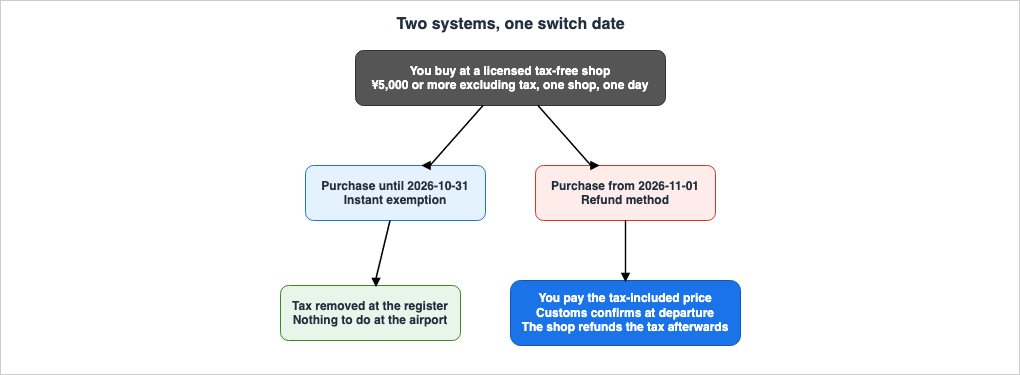
The headline everywhere is "pay first, get refunded later". That part is right, and it is also the least useful part, because the timing of the money is not what will catch you out. Four other things changed at the same time, and three of them are in your favor.
| Rule | Until 31 Oct 2026 | From 1 Nov 2026 |
|---|---|---|
| How you pay | Tax deducted at the register | Full price, refunded after customs confirms departure |
| Minimum spend | ¥5,000 excluding tax, counted separately for general goods and for consumables — unless the shop sealed the general goods with the consumables | ¥5,000 excluding tax, everything counted together |
| Daily cap on consumables | ¥500,000 per shop per day | Abolished |
| Sealed packaging | Consumables sealed in a bag you must not open | Abolished |
| "For ordinary personal use" test | Shop had to judge it | Abolished |
| Goods that never qualify | Wide, judgment-based | Gold and platinum bullion and coins; goods that are not taxed anyway |
The combined minimum is the change most likely to help an ordinary shopper. Under the old rules a ¥3,000 shirt and ¥2,500 of sweets in the same shop reached neither threshold on its own. They could be added together only if the shop agreed to seal the shirt in the consumables bag with the sweets — the National Tax Agency left that to the shop. From 1 November 2026 they add up to ¥5,500 automatically, and both qualify.
The minimum is counted per shop per day, with one exception: where a department store or shopping centre runs a single tax-free counter for several shops, the same day's purchases at those shops can be added together.
The sealed bag is gone. "Don't eat it" is not.
This is where English-language summaries go wrong most often. Removing the sealed-packaging requirement is read as "you can now open and use everything you buy". Nothing forbids opening it, but you still cannot have consumed it — and the Q&A advises keeping goods in their box or bag as bought, because packaging that shows a model number is how customs identifies the item.
The National Tax Agency's Q&A still splits goods along the familiar line, consumables versus everything else. What changed is the test: it is now about what is physically left when you reach customs.
- Food, medicine, cosmetics and other consumables. If you have used any of it, customs cannot confirm that those goods are leaving Japan, so the refund does not apply. The instruction is to tell the customs officer rather than to run the item through the tax-free process.
- Everything else. You may use it in Japan — wear the coat, carry the bag — as long as it leaves the country with you.
One missing item can kill an entire receipt
Customs confirmation is done per purchase record, which in practice means per receipt. The Q&A is blunt about the consequence: if even one item on a receipt is not with you when customs checks, nothing on that receipt is confirmed, including the items you are holding.
The agency gives two worked examples. In the first, a ¥91,000 receipt has three items; the shopper still has the ¥3,000 item and the ¥75,000 item but not the ¥13,000 one, and the refund on all three is lost. In the second, the same ¥91,000 receipt is held in full but a ¥8,000 item from another shop is not: only that ¥8,000 receipt fails, while the ¥91,000 one and a ¥7,000 receipt from a third shop are confirmed.
Two practical consequences follow. Keep tax-free purchases together rather than distributing them across suitcases you may check in separately. And if you plan to give something away in Japan, buy it on its own receipt.
Clear customs before you check your bags

The single most expensive mistake available here costs nothing to avoid. Customs cannot confirm goods that are already in the hold. The Q&A states it directly: confirmation cannot be received after you have checked your baggage. The confirmation itself is done at a tax-free kiosk terminal in the departure lobby, where you show your passport; customs staff look at the goods only if the terminal flags you. So the kiosk comes first.
At seven airports — Narita, Haneda, Kansai, Chubu Centrair, Fukuoka, New Chitose and Naha — the Japan Tourism Agency also lets you do the same procedure online with Visit Japan Web instead of at the kiosk, connected to a dedicated Wi-Fi network in the international departure lobby, up to the security check. That changes where you stand, not the order: the goods still have to be with you, so it still comes before bag drop.
That inverts the usual airport routine, in which you drop your bags and then relax. Budget the time before check-in, not after security.
Ninety days, counted from the day after you buy
The goods have to be confirmed by customs at departure within 90 days of the purchase date. Counting starts the day after purchase, so a purchase on 1 November 2026 has to clear customs by 30 January 2027. The calculator above does this arithmetic and compares it with your flight.
For a normal two-week holiday the window is irrelevant. It matters for two groups: people making several trips in a season who buy on an early visit, and residents-to-be who shop while still on a short-stay entry.
Who can buy tax-free at all
Broadly, non-resident foreign visitors on a short-stay entry, plus Japanese nationals who have lived abroad for at least two years and can document it. The reform relaxed the documentation for the second group and rewrote the procedure for cruise passengers. If you live in Japan it does not apply to you, whatever your nationality — with the exceptions the rules name: people residing under a diplomatic or official status of residence, and members of the US forces in Japan and others covered by the Status of Forces Agreement.
Check that the shop is still licensed
The refund method runs on a national electronic system. A shop that has not registered for it by 31 October 2026 loses its tax-free license from 1 November 2026. A "TAX-FREE" sign in a window may predate that, so it is not a guarantee about today — the counter staff will tell you in seconds, and it is worth asking before you queue.
Two things that are not this
Duty-free allowances on arrival are a different tax entirely: what you may bring into Japan without paying duty. Three bottles of alcohol, 200 cigarettes, ¥200,000 of everything else. It has no connection to the refund on your shopping.
Shipping your purchases home instead of carrying them stopped qualifying for tax-free treatment on 1 April 2025. Direct export arranged by the shop is a different route and still exists, but it is not the same thing as posting a parcel to yourself.
Related tools
- Japan lodging tax calculator — the other Japanese tax that changes by date and by city, and that is not in the price you were quoted.
- How we verify — which primary sources this page was built from and when they were last read.
Sources
- National Tax Agency — Moving the export goods sales system to the refund method
- National Tax Agency — Q&A on the export goods sales system (refund method), July 2026 — PDF, Japanese. The per-receipt rule is Q37; the serial-number rule is Q95–97.
- National Tax Agency — Q&A (refund method, overview edition), revised April 2026 — PDF, Japanese. The abolished requirements are set out under Q4.
- Japan Tourism Agency — Tax-free shopping for travelers: customs confirmation at a kiosk terminal, or online with Visit Japan Web at seven airports
- National Tax Agency — Notice to travelers on the customs confirmation (English, PDF)
- Japan Tourism Agency — FAQ for tax-free shops (who bears a refund agent's fee, question 17)
- National Tax Agency — Q&A on the system before the refund method, revised February 2025 (question 13: combining general goods and consumables; the ¥500,000 cap)
- National Tax Agency — Special site on the proposed cut of the consumption tax rate on food and drink (not yet law)
- Ministry of Finance — FY2025 tax reform (令和7年度税制改正) pamphlet, consumption taxation
Figures on this page last checked against the sources above on 2026-09-01.