
Bringing medicine into Japan — what needs permission, and what is refused outright
Medicine import checker
This page is about customs paperwork, not about treatment. It does not discuss doses, does not compare medicines, and will never suggest a substitute for something you have been prescribed. Where the answer is that a substance cannot enter Japan, that is a conversation to have with the doctor who prescribes it — before you book, not at the airport.
The ingredient decides, and the brand tells you nothing
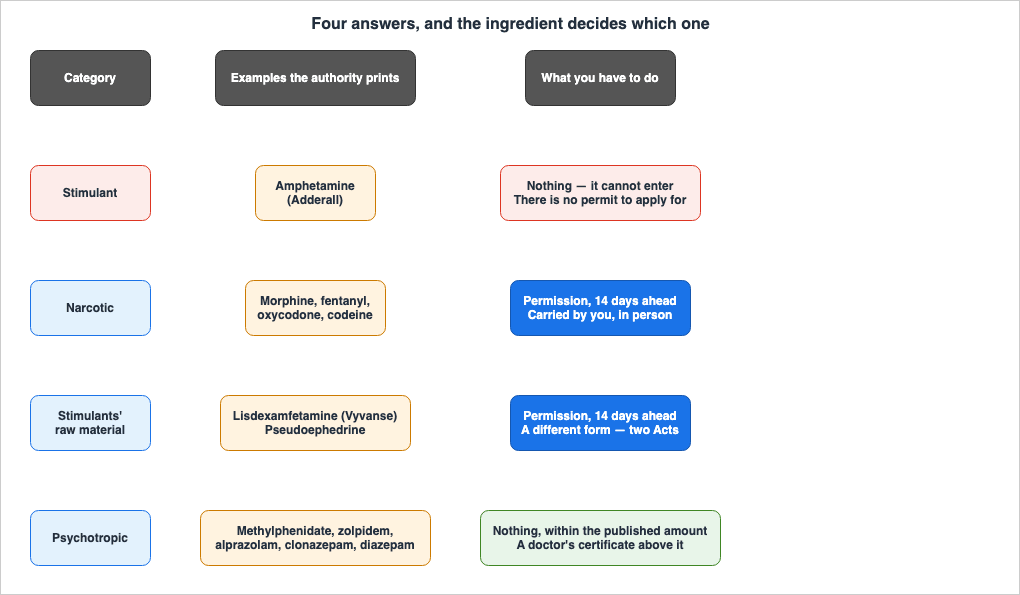
The clearest example is a pair of drugs prescribed for the same condition:
- Adderall cannot come in. Its active ingredient, amphetamine, is a Stimulant under the Stimulants Control Act. The Narcotics Control Department answers this exact question on its own site, and the answer is no — not with a permit, not with a prescription, not for treatment.
- Vyvanse can. Its active ingredient, lisdexamfetamine, is a Stimulants' Raw Material, and that category has an application route. Apply, receive the permission, carry it.
Nothing about the two boxes on a pharmacy shelf tells you that. The authority is explicit about it: its own list of controlled substances does not include brand names, and it tells you to check the category with the doctor who prescribed the medicine. That is why the tool above asks for an ingredient and refuses to guess from a brand.
The four answers
1. It cannot enter Japan
Heroin, opium powder, methamphetamine, amphetamine and methaqualone may not be carried in or out by anyone, "even if these are prescribed medicines in your country". Cannabis in plant form — the whole plant, the flowering top or the leaf — cannot either. Other cannabis products and THC are listed as narcotics rather than as prohibited, and CBD products have rules of their own; ask the Narcotics Control Department before carrying anything derived from cannabis. No form exists for this — the honest thing a page can tell you is to raise it with your prescriber early, and this site is not qualified to say more than that.
2. Permission, applied for at least 14 days ahead
Narcotics — morphine, fentanyl, oxycodone, codeine, tapentadol, GHB — and stimulants' raw materials — lisdexamfetamine, pseudoephedrine — need permission from a Regional Bureau of Health and Welfare before you fly. There is no fee.
The two in bold are the ones that catch ordinary travelers rather than patients on strong medication. Codeine is in cough and cold preparations sold without much ceremony in many countries. Pseudoephedrine is a decongestant you can buy off a shelf. Neither is exotic; both are on the list.
Both are on it above a set strength. The list excludes "any substances containing 1% or less of codeine or its salt" and "any substances containing 10% or less of ephedrine or pseudoephedrine". The figure that counts is the concentration in the product, which a box rarely prints that way — so if you cannot confirm it, treat the medicine as needing permission and ask the Narcotics Control Department before you fly.
Four details of the permission surprise people:
- You must carry it yourself. The permission does not let you post the medicine ahead, and you cannot hand it to anyone else to bring — the Narcotics Control Department's own wording is "you can't also entrust carrying it to other people, such as your family".
- Apply to the office that covers your arrival airport. The Narcotics Control Department has regional offices, and the application goes to the one in charge of the airport where you enter Japan — the entry airport, if you arrive and leave through different ones.
- The doctor's certificate has a shelf life — issued within the last three months — and it must give the specific reason you take the medicine. "For personal use" is rejected.
- Apply for the export permission too if you are flying home with what is left. Narcotics and stimulants' raw materials are governed by two different Acts and use two different forms, so one application cannot cover both categories either.
3. Nothing, if you stay inside the published amount
Psychotropics — methylphenidate, zolpidem, alprazolam, clonazepam, diazepam, buprenorphine — need neither a certificate nor permission, provided the quantity is at or below the per-substance figure in the published table and the form is not injectable. Above that, carry a copy of the prescription or a certificate from the prescribing doctor. Separately, an injectable psychotropic, or about a month's supply or more of any other form, needs an Import Confirmation from a Regional Bureau of Health and Welfare before you travel. The department's page says one month or more and the ministry's says more than one month, so apply if you are near that line.
4. Nothing, because it is not controlled at all
Tramadol is the one the department calls out by name: it is not a narcotic. It is still a prescription medicine, so the one-month quantity allowance below applies to it.
The quantity allowance, for everything else
If nothing in your bag is a controlled substance, the question becomes how much of it there is. Up to these amounts, there is no application to make:
| What it is | How much |
|---|---|
| Prescription medicine, poison or deadly poison | 1 month's supply |
| Over-the-counter medicine or quasi-drug | 2 months' supply |
| External use — ointment, eye drops (not prescription-only) | 24 per item |
| Injectable medicine with its syringe, pre-filled or as a self-injection kit | 1 month's supply |
| Cosmetics | 24 per item |
| Household medical device | 1 set |
| Disposable contact lenses | 2 months' supply |
Over the allowance, you apply for an Import Confirmation before leaving home and show it at customs. Which office handles it depends on where you land: Narita and Haneda go to the Kanto-Shin'etsu bureau, while Kansai, Chubu Centrair, Fukuoka and Naha go to Kinki. Some applications can now be made online.
⚠ Note the wording on the injectable row. The allowance covers the medicine and its syringe together, as a pre-filled syringe or a self-injection kit. Syringes by themselves are a medical device with no free allowance at all.
It was called the Yakkan Shoumei
薬監証明 was replaced by 輸入確認証 — Import Confirmation — on 1 September 2020. Almost every English guide, and a good number of Japanese ones, still call it the Yakkan Shoumei, and one regional bureau still has the old word in its URL. It is the same piece of paper; searching for either name will find it.
Two lists that ignore quantity
The ministry keeps a list of named products that risk serious harm when taken without a doctor's supervision — mostly slimming and "health" capsules found to contain undeclared medicine. None of them may be imported by an individual, at any quantity, without a prescription or equivalent. There is no exception for visitors.
The second list is of ingredients in products sold abroad as enhancing brain function or other mental effects. It names 25 of them, and several are ordinary prescription medicines: atenolol, propranolol, furosemide, levetiracetam and atomoxetine among them. A product containing one needs an Import Confirmation at any quantity unless its use follows a doctor's prescription or instruction. There is a carve-out that matters for readers of this site: bringing it in yourself, for your own treatment during your stay and within the ordinary quantity allowance, needs no confirmation.
⛔ The English page that comes up first is from 2000
Search for official guidance on this and one of the top results is a page on the ministry's own domain that is dated 1 August 2000. It is signed by the "Ministry of Health and Welfare" — a ministry that ceased to exist in 2001 — it gives a vitamin allowance the current guidance does not carry, and it predates the 2020 rename by twenty years. It is still live and still indexed.
The current English page is a different one, linked under "For foreigners and travelers" from the ministry's personal-import portal, and it is the one this tool is built from. Both are listed in the sources below so you can see the difference for yourself.
Related
- What you cannot bring into Japan — the food, plant and counterfeit side of the same border.
- Trip checklist — where this sits in the order of things at the airport.
- Duty-free allowance — the tax question, which is separate.
Sources
- MHLW — Information for those who are bringing medicines for personal use into Japan
- MHLW — 医薬品等の個人輸入について
- MHLW — 医薬品等を海外から購入しようとされる方へ — Names the two bureaux and the customs districts each one covers.
- Narcotics Control Department, MHLW — Application Guidance
- 麻薬取締部 — 麻薬・覚醒剤原料などを携帯して日本を出入国する方へ
- Narcotics Control Department — Controlled Substances List (12 December 2024; PDF) — Only cannabis in plant form carries the prohibited mark; other cannabis products and THC are listed as narcotics.
- MHLW — ingredients needing confirmation at any quantity when sold for brain-function claims (PDF, Japanese) — The visitor carve-out, and its cap at the ordinary quantity allowance.
Figures on this page last checked against the sources above on 2026-09-01.