
What you cannot bring into Japan — and why the ham is the serious one
Import restriction checker
This is not the duty-free allowance
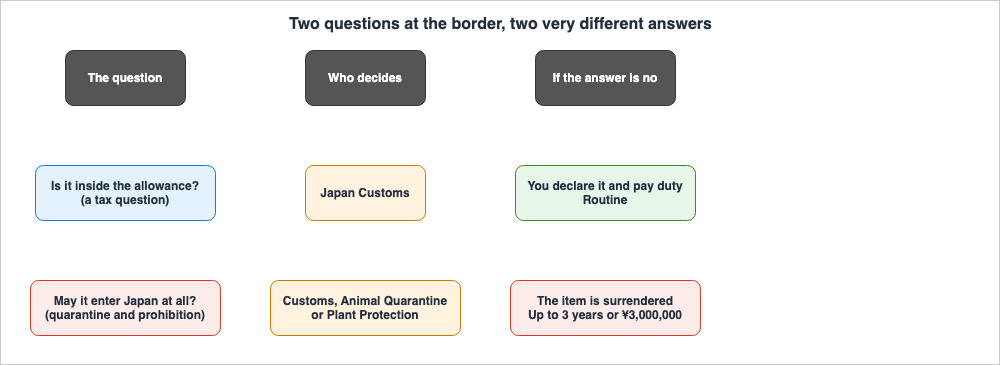
Two different questions get asked at the same airport, and confusing them is expensive.
- Is it inside the allowance? A tax question. Going over means declaring it and paying duty. Routine. Calculate it here.
- May it enter Japan at all? A quarantine and prohibition question. "No" means the item is surrendered — and for the quarantine offenses, the penalty is up to three years' imprisonment or a fine of up to ¥3,000,000.
A ¥3,000 packet of jerky is well inside every allowance and cannot enter the country.
Meat is the one people get wrong
Meat from cloven-hoofed animals, horses, poultry, dogs and rabbits is subject to animal quarantine in any form. Not "raw meat" — any form:
- Cooked, cured, dried, vacuum-packed
- Bought in an airport duty-free shop
- Labeled in Japanese
- Containing only a little meat: a meat bun, a gyoza, a hamburger, a ham sandwich, kimbap
Eggs, bones and other raw animal parts are covered too. A finished leather bag or wool sweater is not, nor is honey, nor cheese or other dairy carried in your luggage.
For meat, the ordinary route in is an inspection certificate for Japan issued by the exporting country's government, presented at the animal quarantine counter — which sits before customs. For something bought in a shop as a souvenir, such a certificate is in practice almost impossible to obtain. There are two narrow exceptions: meat products sold in the United States, Canada, Australia and New Zealand with that certificate printed on the package, and some canned, bottled or retort products that are unopened, contain liquid and keep for 12 months or more at room temperature. Both still go through the quarantine counter.
And even with the certificate: opening the packet before the inspection disqualifies it.
Most fresh fruit cannot come either
The Plant Protection Station names mango, longan, guava, lychee, chilli, citrus, pear and apple among the prohibited items. The purpose is to keep out pests such as the oriental fruit fly and diseases such as fire blight, which is why quantity makes no difference: one apple is the same problem as a crate.
Seeds, seedlings, cut flowers, grain and beans are not prohibited outright but need a phytosanitary certificate from the government of the country you are leaving. Many dried or processed plants — tea, spices, herbal medicines, dried vegetables, dried flowers — need only the inspection, and finished wooden or bamboo goods and furniture are outside plant quarantine altogether. Soil, and any plant with soil on it, is prohibited — including mud on boots you wore on a farm.
Your leftover in-flight meal counts
It contains meat, or fruit, or both. It cannot be brought in. Airports have voluntary disposal bins before the counters, and using one is the right move. It is not an amnesty, though: the Animal Quarantine Service says illegal imports are dealt with strictly whether or not the goods are abandoned.
If you visited a farm
Say so at the quarantine counter. They will disinfect your shoes, and ask you to stay away from Japanese livestock for about a week. This is a request rather than a punishment, and declaring it costs you a few minutes.
The most recent change, and why it is narrow
—
It is worth knowing about because a change like this is easily reported as "Japan relaxes food import rules", which it is not. Meat products remain covered exactly as before. The next change goes the other way: from 1 January 2027, animal teeth are added to the products subject to quarantine.
The prohibitions that are not about food
| Category | Status |
|---|---|
| Narcotics, stimulants, firearms and parts, ammunition, explosives | Prohibited under the Customs Act — except, for narcotics, a prescribed medicine carried with the health ministry's permission (see medicines). This is the category where people go to prison |
| Counterfeit brand goods, pirated media | Not targeted when you carry them in yourself for your own use — Japan Customs says so in its FAQ. Stopped where there is a business element, and when an overseas seller posts them to you, even for your own use |
| Ivory, reptile leather, coral, orchids, some traditional medicines | CITES — needs an export permit from the country of origin or an import approval from METI |
| Cash and equivalents over ¥1,000,000 | Allowed, but must be declared |
The CITES row catches more travelers than expected. A souvenir sold openly in a shop abroad is not exempt, and a great many tourist products — carved ivory, snakeskin, coral jewelry, orchids — are covered.
Medicines are a separate question again
Some medicines that are ordinary at home contain substances that are controlled in Japan, and that is decided by the health ministry rather than by customs or quarantine. It has nothing to do with the allowance or with quarantine, and it is worth checking before you pack rather than at the counter.
Related tools
- Duty-free allowance calculator — the tax question, which is the routine one.
- Tax-free refund calculator — the third thing called "tax-free", about shopping done in Japan.
- How we verify — why this page works from the Japanese pages of three separate authorities.
Sources
- Japan Customs — Prohibited and restricted imports and exports
- Japan Customs — Customs Answer 2001, goods that may not be imported
- Japan Customs — FAQ on the tightened border control of counterfeit goods (16 February 2024)
- Japan Customs — Customs Answer 9008, CITES for travelers
- Animal Quarantine Service — Meat products as souvenirs
- Animal Quarantine Service — Act on Domestic Animal Infectious Diseases Control, penalties
- Plant Protection Station — A request to visitors to Japan
- Plant Protection Station — Plants outside import plant quarantine (processed wood, bamboo and furniture)
- Plant Protection Station — Plants exempt from the phytosanitary certificate
- MAFF — FAQ on bringing meat products into Japan (labeled products, dairy, shelf-stable cans, the week after a farm visit)
Figures on this page last checked against the sources above on 2026-09-01.