
Japan duty-free allowance calculator — what you can bring in
Duty-free allowance calculator
Allowances last checked against Japan Customs on —. Nothing you type leaves the page.
This is not the "tax-free" you saw in the shop window
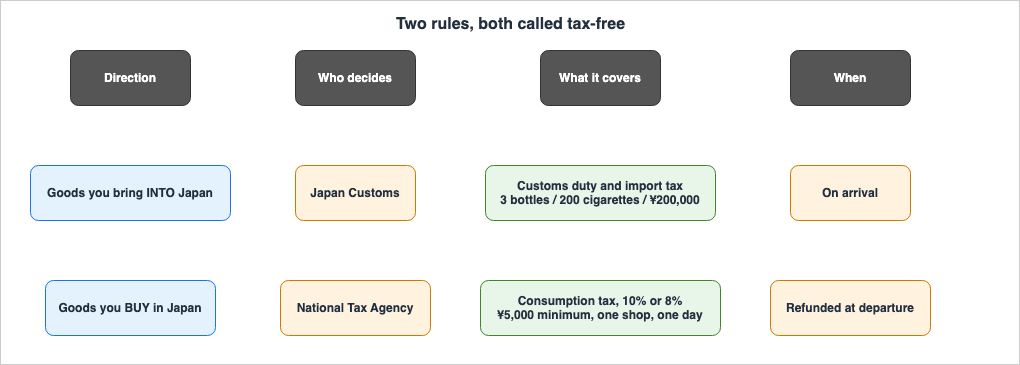
Japan has two rules that both get called "tax-free" in English, and they point in opposite directions.
- This page — customs duty and tax on goods you carry into Japan. Decided by Japan Customs when you land.
- Tax-free shopping — consumption tax on goods you buy in Japan and take home. Decided by the National Tax Agency, refunded when you leave.
Using one allowance does not affect the other. Buying ¥180,000 of cameras tax-free in Akihabara does not consume any part of your arrival allowance, because that allowance was spent before you ever reached the shop.
The allowance in full
| What | Allowance | Notes |
|---|---|---|
| Alcohol | 3 bottles | A bottle counts as 760 ml |
| Cigarettes only | 200 sticks | Since 1 October 2018 the allowance no longer distinguishes residents from visitors, or Japanese brands from foreign ones |
| Heated tobacco only | 10 individual packages | |
| Cigars only | 50 sticks | |
| Other tobacco | 250 g | |
| Perfume | 2 ounces | About 28 ml an ounce. Eau de cologne and eau de toilette are not counted here |
| Everything else | ¥200,000 | Total overseas market value |
Under 20 there is no alcohol or tobacco allowance at all. Under 6, only items that are clearly for the child's own use — toys and the like — are allowed.
The ¥10,000 rule, and how it is counted
This is the part worth knowing. The English page states it in one line — "Any item whose overseas market value is under 10,000yen is free of duty and/or tax and is not included in the calculation of the total overseas market value of all articles" — but the Japanese page is more precise about how it is counted, and it is the only one that gives examples.
An item type whose total overseas value is ¥10,000 or less is, as a rule, exempt, and does not count toward the ¥200,000 allowance at all.
It is the total for each type of item that is compared with ¥10,000. Customs gives two examples: nine chocolates at ¥1,000 each, and two neckties at ¥5,000 each. Both are exempt, and neither eats into your ¥200,000.
In practice this means a suitcase full of modest souvenirs is very hard to bring over the line. What brings people over is a single expensive object.
One expensive item is taxed on its whole value
If a single item is worth more than ¥200,000, the allowance is not deducted from it. Customs' own example: a ¥250,000 bag is dutiable on ¥250,000, not on the ¥50,000 above the allowance.
When the total goes over ¥200,000 across several items, customs exempts whichever items fit inside the allowance and taxes the rest. The calculator above fits the most expensive items in first, which is the arrangement that leaves you paying the least.
Going over is not a problem — hiding it is
Being above the allowance simply means declaring it and paying duty on the excess. The rate depends on what the item is, which is why the tool shows the value you would declare rather than a figure of duty.
What is genuinely a problem is a false declaration. Every arriving passenger files a customs declaration; getting it wrong deliberately is a different matter from paying a few thousand yen of duty.
Unaccompanied baggage counts too
Things shipped separately count against the same allowance, and must be imported within six months of your arrival. Declare them on arrival — that is what the second copy of the declaration form is for.
The allowance is not the same question as admissibility
Everything above is about tax. Whether an item may enter Japan at all is a separate question with separate authorities: meat and fruit are controlled by animal and plant quarantine, medicines by the health ministry, counterfeit goods by customs itself. An item can be well inside your ¥200,000 and still be refused entry.
Related tools
- Tax-free refund calculator — the other "tax-free", and what changes on 1 November 2026.
- How we verify — why this page works from the Japanese customs page rather than the English one.
Sources
- Japan Customs — Duty-free allowance for travelers — Japanese. The ¥10,000 per-item rule and its worked examples are on this page and not on the English summary.
Figures on this page last checked against the sources above on 2026-09-01.