
Visa-free stay in Japan — how long, and the conditions on 25 of the 74 countries
Visa-free stay checker
This page cannot tell you whether you need a visa, and does not try. It reports what the Ministry of Foreign Affairs publishes about the exemption arrangements. Entry is decided by an immigration inspector on the day, and the visa question belongs to the Japanese embassy or consulate for where you live.
Being on the list is not the answer
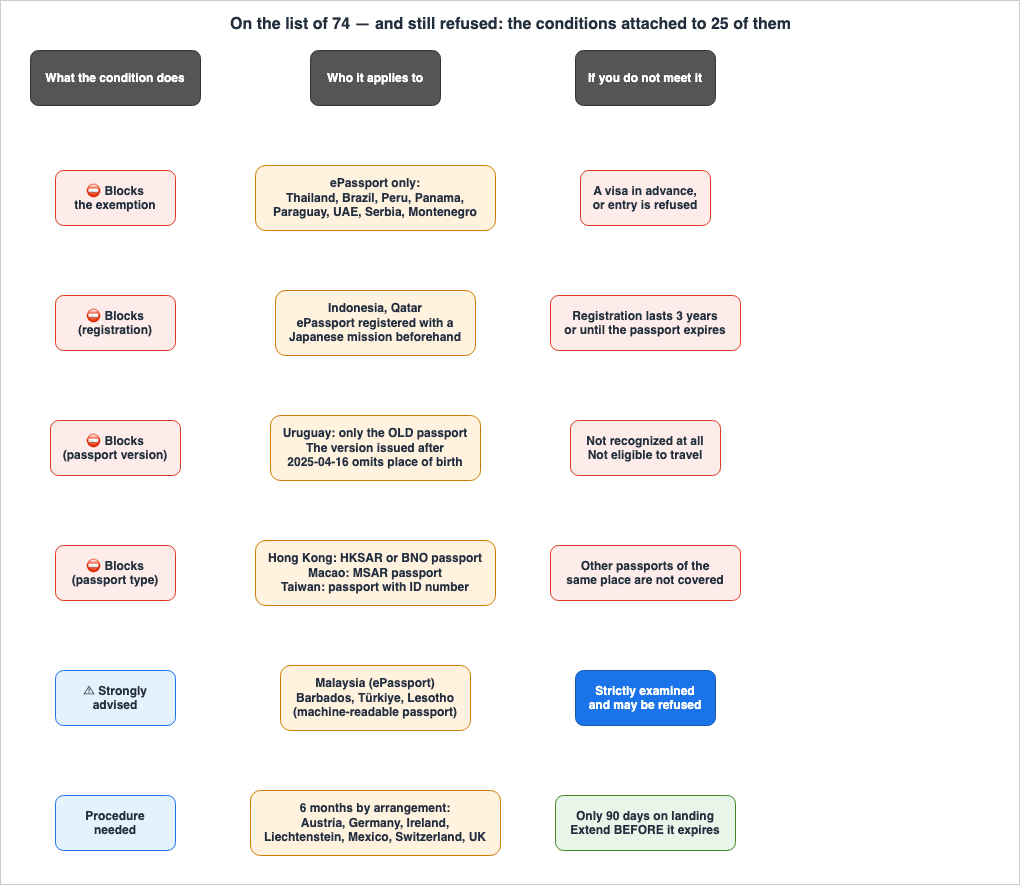
Japan has reciprocal visa exemption arrangements with 74 countries and regions. Almost every English page that covers this reproduces the list and stops there. A third of the entries carry a condition, and four kinds of condition are absolute — an ePassport, a registered ePassport, the right passport version, the right passport type: meet them or the exemption simply does not apply to you.
Conditions attached to each country
| Country or region | Condition |
|---|
⛔ The one worth reading twice is Uruguay. The new ordinary passport issued after 16 April 2025 leaves place of birth off the data page, and the Japanese government does not recognize it as valid — those holders are not eligible to travel to Japan under the exemption at all. An old-version passport stays eligible even if it was issued after that date.
How long you get: 90 is a ceiling, not an entitlement
The period granted on landing is 15 days for Indonesia and Thailand, 30 days for Brunei and Qatar, and 90 days for everyone else.
But the statute the Immigration Services Agency publishes says the status carries a period of "90, 30 or 15 days — or any number of days up to 90 that the Minister of Justice designates for a particular person". The inspector can write a shorter period on the sticker, and that is what binds you. There is no entitlement to 90 days.
⚠ Seven countries have a six-month arrangement and still get 90 days
Austria, Germany, Ireland, Liechtenstein, Mexico, Switzerland and the United Kingdom have arrangements permitting stays of up to six months. That is not what you are granted at the border. To stay beyond 90 days you must apply to a Regional Immigration Bureau to extend the period of stay before the granted period expires. It is not automatic and it is not done at the airport.
⛔ Why this page gives you two possible last days
Every other page on this subject prints one date. We could not establish which of two counting rules applies, so we print both.
- The everyday explanation is that the day you land is day 1: land on 1 April with 90 days and the period ends on 29 June.
- But immigration practitioners apply the Civil Code rule that the first day is not counted to the deemed re-entry permit's "one year from the day of departure", and the same rule would make it 30 June. The agency's own pages give the period without saying how the first day is counted.
Three searches of the ministry's site and the government's law database found no provision fixing the count for a landing permission. So the tool shows both and tells you to plan to the earlier one. Planning a day early costs you nothing; the opposite error is an overstay.
The date printed on the landing permission sticker in your passport is the only one that counts. Check it on the day rather than trusting any calculator, including this one.
Leaving Japan ends the stay
A re-entry permit is, as a rule, not granted to someone on a short-stay status, and short stays are not covered by the deemed re-entry permit either. So stepping out to Seoul or Taipei does not pause the clock — it ends the stay, and coming back is a new entry, judged afresh, with a new period granted at the border.
⚠ That is the legal position, not a technique. Each landing is a separate decision by an inspector who can see the previous ones, and who can refuse. If you know in advance that you will step out and come back, the published advice is to ask about a multiple-entry visa when you apply at a Japanese mission.
Extending a short stay is not a way to lengthen a holiday
The Immigration Services Agency grants an extension of a short-term stay, as a rule, only where there are "genuinely unavoidable humanitarian reasons or something comparable", and the example it gives is needing medical treatment. The six-month arrangements above are the exception: there the extension is the expected route past 90 days. An application asks for a written reason, an account of what you have done since arriving, and evidence that you can pay for the rest of the stay and for leaving — a bank balance or a return ticket.
Coming, but not yet: JESTA
An amendment passed on 29 May 2026 creates JESTA, an electronic travel authorization for visa-exempt visitors. It is not in force. The Immigration Services Agency gives its start as a date to be set by cabinet order no later than 31 March 2029, and the fee has not been set. Until the date is announced, nothing on this page changes because of it.
Related
- Trip checklist — the rest of what your two dates decide.
- Peak season checker — whether those dates are the busy ones.
- Airport charges — what the departure costs before the fare.
Sources
- MOFA — Exemption of Visa (Short-Term Stay) — The list of 74 and all eleven notes. Page last updated 1 September 2025.
- Immigration Services Agency — 在留資格「短期滞在」 — The statutory period — 90, 30 or 15 days, or any number of days up to 90 designated for a particular person — and the narrow grounds for extending it.
- Immigration Services Agency — 出入国審査・在留審査Q&A (Q62) — A re-entry permit is, as a rule, not granted on a short stay, and leaving Japan means the next arrival is a new entry.
- Immigration Services Agency — 令和8年入管法等改正法について (JESTA) — Passed 29 May 2026, promulgated 5 June 2026 (Act No. 32); JESTA from a date set by cabinet order no later than 31 March 2029.
Figures on this page last checked against the sources above on 2026-09-01.