
Japan holiday and peak season checker — are your dates the busy ones?
Peak season checker
Holiday data last checked against the Cabinet Office on —. The check runs in your browser.
One of the three busiest periods is not a public holiday
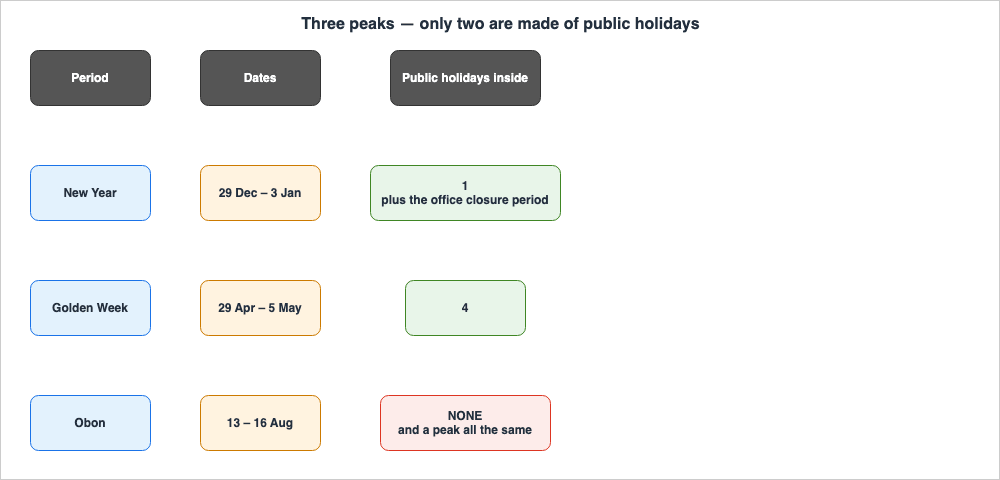
Japan has three periods when the whole country travels at once. Only two of them are built out of public holidays.
| Period | Dates | Public holidays inside |
|---|---|---|
| New Year | 29 Dec – 3 Jan | One (1 January) |
| Golden Week | 29 Apr – 5 May | Four |
| Obon | 13 – 16 Aug | None |
Obon is the customary period for returning to one's family home. Nothing about it is legally a holiday, and it is a peak all the same: on the Tokaido Shinkansen, JR Central counted 4.09 million passengers over ten days of Obon 2025, against 4.42 million over ten days of New Year. This is why a calendar of Japanese public holidays — which is what most English pages give you — will happily tell you that mid-August is clear.
What a peak period actually changes
- Reserved seats sell out. Shinkansen reservations open a month ahead — up to a year ahead for some seats on JR's Express Reservation and smartEX — and Golden Week departures go quickly. On the Tokaido and Sanyo Shinkansen, every Nozomi runs all-reserved over Golden Week, Obon and New Year, and in 2026–27 also over Silver Week and the three-day weekends from October to March. An unreserved ticket still lets you ride a Nozomi standing in the deck; Hikari and Kodama keep their unreserved cars, and those fill up. The calculator tells you if your dates touch one of these periods.
- Accommodation gets more expensive, and in resort towns considerably so. Note that lodging tax is banded in most cities, so a higher room rate can also push you into a higher tax band.
- Small businesses close. Over New Year especially: family restaurants, clinics, small museums and many shops shut for several days. Convenience stores and chains stay open.
- Cities empty out at Obon while the countryside fills up. Tokyo in mid-August is one of the quieter times to see it.
None of this makes a trip a bad idea. It makes an unbooked trip a bad idea.
Three days is where it starts
Outside the three big periods, what matters is the length of the run of non-working days. Japan moves several holidays to Mondays specifically to create three-day weekends, and domestic travel responds to them.
- Two days — an ordinary weekend. No particular effect.
- Three days — domestic short trips. Popular ryokan and reserved seats tighten.
- Four or more — behaves like a small Golden Week.
The tool above reports the longest run touching your dates, looking a week either side, because a run that starts the day after you leave still affects your last night's hotel price.
Two holidays are not knowable far ahead
Vernal Equinox Day in March and Autumnal Equinox Day in September are set by the position of the sun, and the dates become official only when the National Astronomical Observatory's almanac is published in the February of the preceding year.
They can be approximated, and approximations are occasionally wrong. This tool carries the Cabinet Office's published values instead, which is why it says plainly when your dates run past the end of the published list rather than guessing.
Holidays that land on a Sunday move
When a public holiday falls on a Sunday, the following working day becomes a holiday in lieu. A weekday sandwiched between two holidays becomes a holiday too, as 22 September 2026 does, between Respect for the Aged Day and Autumnal Equinox Day. The Cabinet Office list calls both kinds simply 休日; the tool names each for what it is. Both of these are in the published data, so the counts above include them without any special handling — which is exactly why using the published list matters more than it sounds.
Related tools
- Lodging tax calculator — peak-season room rates can cross a tax band.
- Japan Rail Pass calculator — worth re-running for peak dates, when you may be buying reserved seats you would otherwise skip.
- How we verify — why the equinox dates are taken from a published list rather than calculated.
Sources
- Cabinet Office — National holidays (published list) — The tool carries these published values rather than calculating the equinox holidays.
- Act on National Holidays (Act No. 178 of 1948)
- JR Central — Use over the 2025 New Year period (Tokaido Shinkansen and conventional lines; PDF)
- JR Central — Use over the 2025 Obon period (Tokaido Shinkansen and conventional lines; PDF)
- smartEX — Nozomi all-reserved during the New Year period (states the rule for all three peaks)
- National Astronomical Observatory of Japan — Koyomi Yoko — The source of the equinox dates, fixed each February for the following year.
Figures on this page last checked against the sources above on 2026-09-01.