
8% or 10%? Japan's two consumption tax rates, and the question at the till
Consumption tax rate checker
Rules last checked against the National Tax Agency on —.
Proposed, not yet law: 1% on food and drink from 1 April 2027 to 31 March 2029. The Cabinet adopted an outline on 15 September 2026 to cut the 8% rate on food and non-alcoholic drink to 1% for two years, and submitted the bill to the Diet on 9 October 2026. It has not been passed yet. Newspapers on a subscription would stay at 8%; alcohol and eating in stay at 10%. This page and its calculator use the rates in force today.
The line is not "food versus everything else"
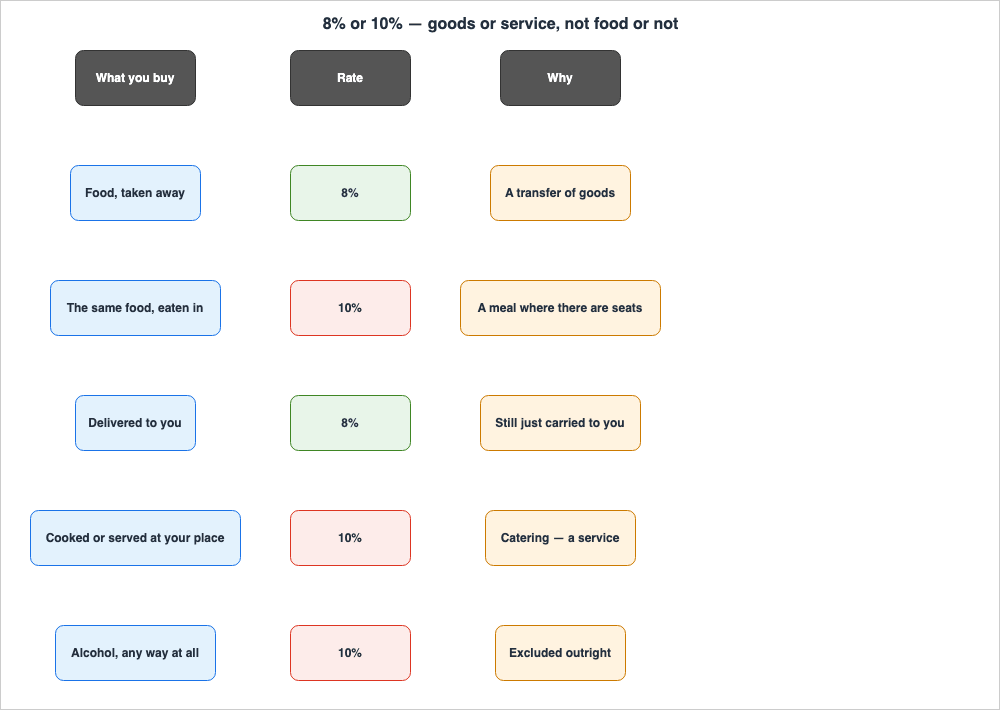
Japan's reduced 8% rate covers food and non-alcoholic drink, and the exceptions are what confuse people. The distinction the law draws is between a transfer of goods and a service:
- Handing you a bento to carry out is a transfer. 8%.
- Serving you the same bento where there are seats is a meal. 10%.
- A courier bringing you a pizza is still a transfer. 8%.
- A cook coming to your accommodation to prepare and serve it is catering. 10%.
So the rate does not track how healthy or how luxurious the item is. It tracks whether someone is doing something for you beyond handing it over.
The rate is fixed by what you say, not by the container
This is the rule visitors do not expect. The shop decides the rate at the moment of sale, based on your answer to "eat in or take away?" — either asked directly or through a notice asking you to say if you will use the seating.
The National Tax Agency's circular then adds the part that surprises people: if you said you would eat in, and the staff nevertheless hand it to you in a takeaway bag, it is still 10%. The container does not decide it. Your declaration does.
Which also means the reverse: taking a seat after saying you would take it away does not retroactively change what you were charged. The convenience-store question is not a formality — it is the taxable event being determined.
Almost anything counts as somewhere to eat
"Facilities for eating" is read very broadly: a table, a chair, a counter, whatever the size or the purpose. A rest area in a supermarket qualifies. That is why supermarkets and convenience stores ask, and why they will sometimes have two prices on the same shelf label.
A shop that displays "please do not eat here" — and genuinely does not allow it — has no eating facilities, sells takeaway only, and does not need to ask. But the sign alone is not enough: if people are in fact eating there, the sale is a meal at 10% whatever the notice says.
A set is one product
Buy a burger-and-drink set, drink the drink at the counter and carry the burger out, and the whole set is 10%. It is a single product, and part of it was served to you to consume there.
Buy the two as separate items and each is judged on its own: the burger 8% taken away, the drink 10% consumed in. If you care about the difference, order them separately.
The catering line: plating counts, pouring does not
Catering is defined as provision that comes with heating, cooking or serving at a place you nominate. Heating, cutting, seasoning, arranging on plates, laying out crockery and serving all count as service, and push the whole thing to 10%.
But routine handling does not. Tipping a takeaway coffee into a cup is part of transferring it; so is pouring miso soup into a serving bowl. The test is whether the food is being made ready for you rather than simply handed over.
What this costs you in practice
On a ¥500 item the difference between 8% and 10% is about ¥9. Over a two-week trip with a few convenience-store meals a day, it is a few hundred yen — which is to say, this is not a rule to optimize around. It is a rule to understand, so that the question at the till makes sense and the two prices on a shelf label are not a mystery.
Where it does matter is at the other end: tax-free shopping refunds whichever rate applied, so food bought for the flight home comes back at 8% and a bottle of whisky at 10%. If the proposed cut is enacted, food bought between 1 April 2027 and 31 March 2029 would come back at 1%.
The reduced rate has exactly one other use, which a visitor will not meet: newspapers published at least twice a week and sold on a subscription. Everything else that is not food or drink is 10%.
Related tools
- Tax-free refund calculator — the rate decides what comes back.
- Trip tax calculator — how much of a whole trip is tax.
- Duty-free allowance — the other tax, on the way in.
Sources
- National Tax Agency — Special site on the proposed cut of the consumption tax rate on food and drink (opened 15 September 2026; not yet law)
- Cabinet Secretariat — Outline adopted by the Cabinet on 15 September 2026 (the 1% rate; newspapers stay at 8%)
- Cabinet Secretariat — the bill approved by the Cabinet and submitted to the Diet on 9 October 2026 (not yet passed)
- National Tax Agency — Tax Answer No. 6102, the reduced consumption tax rate
- National Tax Agency — Consumption Tax Basic Circular §5-9 — 5-9-10 is the rule that the rate is fixed by what the customer says at the time of provision.
- National Tax Agency — Reduced-rate Q&A (individual cases), Part III: the scope of eating out (PDF)
Figures on this page last checked against the sources above on 2026-09-01.