
How much of a Japan trip is tax — and how much comes back
Trip tax calculator
Rates last checked against the issuing authorities on —. Everything runs in your browser.
Only one of these is a charge you were not quoted
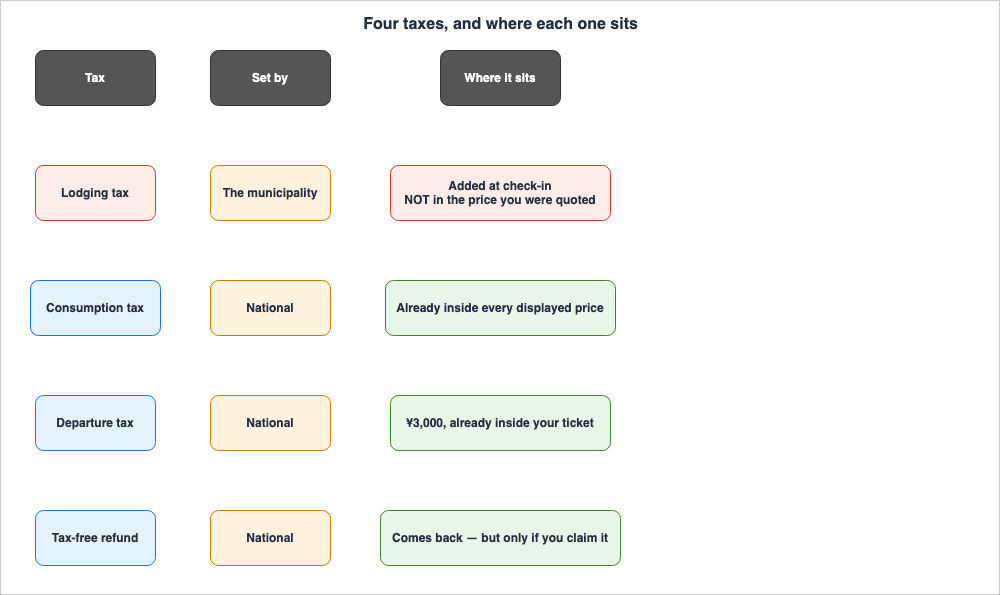
Four taxes touch an ordinary visit. Three of them are already inside prices you have seen, which is why they feel invisible rather than absent.
| Tax | Where it sits | Do you feel it? |
|---|---|---|
| Lodging tax | Added at the property, per person per night | Yes — the one genuine surprise |
| Consumption tax | Inside every displayed price | No |
| Departure tax | Inside your airline ticket | No |
| Tax-free refund | Comes back to you | Only if you claim it |
The departure tax tripled on 1 July 2026
The International Tourist Tax went from ¥1,000 to ¥3,000 per departure. It applies to everyone leaving Japan regardless of nationality — residents included — and the airline collects it inside the fare, so there is nothing to pay at the airport.
The transitional rule is more precise than most reporting suggests. The Tourism Agency's leaflet says "certain tickets issued by 30 June 2026" keep the old ¥1,000. The National Tax Agency's Q&A puts it as: the carriage contract must have been concluded before the raise date and the departure date must already have been fixed. It lists three cases that pay ¥3,000 anyway: an open ticket whose date is set on or after 1 July 2026, a departure date changed on or after that day, and a contract whose terms collect the tax separately from the fare. Children under 2 are exempt entirely, and so are passengers transiting Japan by air who leave within 24 hours on one ticket that shows it — but not passengers transiting by ship.
Consumption tax is invisible by law
Since April 2021 prices shown to consumers in Japan must be tax-inclusive. A ¥1,100 bowl of ramen is ¥1,100 at the till, and ¥100 of it is tax. This is the opposite of the US convention and it catches people out in a pleasant direction rather than an unpleasant one.
The calculator shows the tax inside your spending because it is a real part of the trip's cost, and because some of it — the shopping portion — can come back.
Only shopping can be refunded, and only over ¥5,000
The tax-free refund applies to goods you take out of Japan, from one shop on one day (or at one tax-free counter shared by several shops), totaling ¥5,000 or more before tax. Meals, fares, admission and hotel nights are not refundable no matter how much you spend.
That threshold is why the calculator asks for your shopping separately: a ¥30,000 camera purchase returns ¥2,727, while ¥30,000 spread across five restaurants returns nothing.
A stay that crosses a rate change is charged under both
Lodging tax is per night, so the calculator walks your nights one at a time rather than multiplying. A Kyoto stay from 28 February to 2 March 2026 pays one night at the old rate and one at the new, because 2026 has no 29 February. With Tokyo moving to a percentage in April 2027 and several municipalities changing in 2026, this matters more than it used to.
What this deliberately does not do
It is not a budget planner. Fares, meals, admission and shopping totals are choices, and a calculator that guesses them produces a confident number with no basis. Everything above is fixed by law and can be looked up, which is the only kind of number this site publishes.
Related tools
- Lodging tax calculator — the per-night detail, jurisdiction by jurisdiction.
- Tax-free refund calculator — what comes back, and the 1 November 2026 change to how.
- Peak season checker — dates change room rates, which can change your lodging tax band.
Sources
- National Tax Agency — Outline of the International Tourist Tax (No. 7195)
- National Tax Agency — Q&A on the International Tourist Tax, revised April 2026 (PDF) — Q19–20 give the raise to ¥3,000 and the transitional rule, which is about the carriage contract rather than the ticket.
- Japan Tourism Agency — leaflet on the rate change (PDF)
- Ministry of Finance — FY2026 tax reform outline (Cabinet decision, 26 December 2025)
- National Tax Agency — Q&A on the export goods sales system (refund method), July 2026 (PDF)
Figures on this page last checked against the sources above on 2026-09-01.